DevOps & AI Fluency - Integrating Generative AI into the SDLC
Technical Training in Generative AI for DevOps Teams
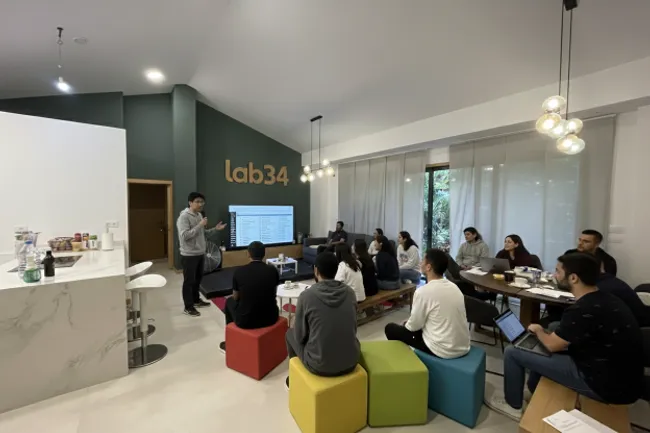
This is not traditional training. It’s an accompaniment program (including reverse KT sessions, hands-on workshops and a handful of AI examples we built at Lab34) designed for technical teams to learn by doing and become fluent professionals in using generative AI throughout the entire software development lifecycle (SDLC).
We start from deep technical fundamentals—the “physics” of LLMs—and then apply them culturally in every phase of the DevOps process, from planning to observability.
Program Structure
The program evolves from deep technical understanding to practical and cultural application in every phase of the DevOps cycle.
Module 1: Technical Fundamentals – The “Physics” of LLMs
Objective: Demystify AI. Understand technical constraints (memory, costs, input/output) to design robust, not “magical” solutions.
1.1 Anatomy of an LLM: Tokens vs. Words
- Token concept and tokenization differences between natural language and code
- DevOps implications: API cost calculation and optimization
- Practical exercise: “The token calculator” - Estimate consumption in Kubernetes configuration files
1.2 The Context Window: The “RAM” of AI
- Short-term memory: Input + Output tokens = Total limit
- The “Lost in the Middle” phenomenon in long contexts
- DevOps implications: Chunking strategies and basic RAG
- Why you can’t “copy and paste” a 1GB log
1.3 Inference Parameters: Controlling the Chaos
- Temperature: Determinism vs. Creativity in different contexts
- Probability and Hallucination: Why the model invents non-existent libraries
- Understanding that it predicts tokens, not absolute truths
Module 2: DevOps Culture and AI Strategy
Objective: Align technical capabilities with DevOps collaboration and trust philosophy.
2.1 The Three Modes of Engineering Interaction
- Automation: Migration scripts, seed data generation
- Augmentation: “Pair Programming” to solve complex incidents
- Agency: Bots that triage Jira tickets or do pre-code reviews
2.2 The 4 D Framework Applied to DevOps
- Delegation: Decision matrix - What task is safe for AI?
- Description: Prompting as a fundamental new technical skill
- Discernment: “Trust but Verify” - AI as junior developer
- Diligence: Ethics, biases, and intellectual property of generated code
Module 3: Planning and Architecture Design
Objective: Use AI to reduce friction in the design phase and foster shared ownership.
3.1 From Requirements to Specifications
- Translate vague User Stories into detailed technical specifications
- Generate Mermaid diagrams and Gherkin specifications
3.2 Platform Design and RFCs
- Overcome “writer’s block” when drafting RFCs (Request for Comments)
- Role simulation: “Act as a security expert and critique this architecture”
- Exercise: Collaborative architecture design with AI critique
Module 4: Development and Test Automation (CI)
Objective: Accelerate feedback cycle (“Shift Left”) through better code and early testing.
4.1 Prompt Engineering for Code
- Chain-of-Thought: Guide AI step by step
- Few-Shot Prompting: Teach team style for consistency
- Maintain repository coherence
4.2 Test and Data Generation
- Generate unit and integration tests
- Edge cases that humans often forget
- Synthetic data and database mocks
Module 5: Infrastructure and Pipelines (CD & IaC)
Objective: Infrastructure automation and reliable deployments.
5.1 Infrastructure as Code (IaC)
- Intention to code translation: From requirements to Terraform/CloudFormation
- Script auditing: Detect security errors before
apply - Exercise: Generate and validate infrastructure configurations
5.2 CI/CD Scripts and Automation
- Generate optimized pipelines (GitHub Actions, GitLab CI)
- Modernize Legacy scripts: From old Bash to Python/Go
- Optimize build times
Module 6: Observability, Security, and Governance
Objective: Close the loop with constant feedback and secure operations.
6.1 Incident and Log Analysis
- Efficient use of context window to analyze error traces
- Write blameless Post-Mortems
- Summarize complex incident timelines
6.2 Security (DevSecOps)
- Vulnerability scanning in generated code
- The risk of exposing secrets (API Keys) to public LLMs
- Best security practices with AI
6.3 Governance and Future
- Company AI usage policy
- Preparation for Autonomous Agents in Operations
- The future of software development with AI
Methodology
- Hands-on learning: Practical exercises in each module
- Based on real cases: Examples from day-to-day DevOps team work
- Fluency over Knowledge: The goal is fluency, not just theoretical knowledge
- Continuous accompaniment: Support beyond formal sessions
- Adapted to your stack: Examples customized to your team’s technologies
Who Is This Program For?
- DevOps/SRE engineering teams
- Developers wanting to integrate AI into their workflow
- Technical Leads seeking strategic AI implementation
- Platform teams wanting to automate with intelligence
Expected Outcomes
Upon completing the program, your team will be able to:
- Deeply understand how LLMs work and their limitations
- Effectively integrate generative AI at every SDLC phase
- Design precise technical prompts and get predictable results
- Critically evaluate code and suggestions generated by AI
- Implement governance and security policies for AI use
- Accelerate development without compromising quality
- Become AI-fluent professionals
Contact
Interested in taking your team to the next level in generative AI? Let’s discuss how to adapt this program to your organization’s specific needs.